
An overview for operational decisions
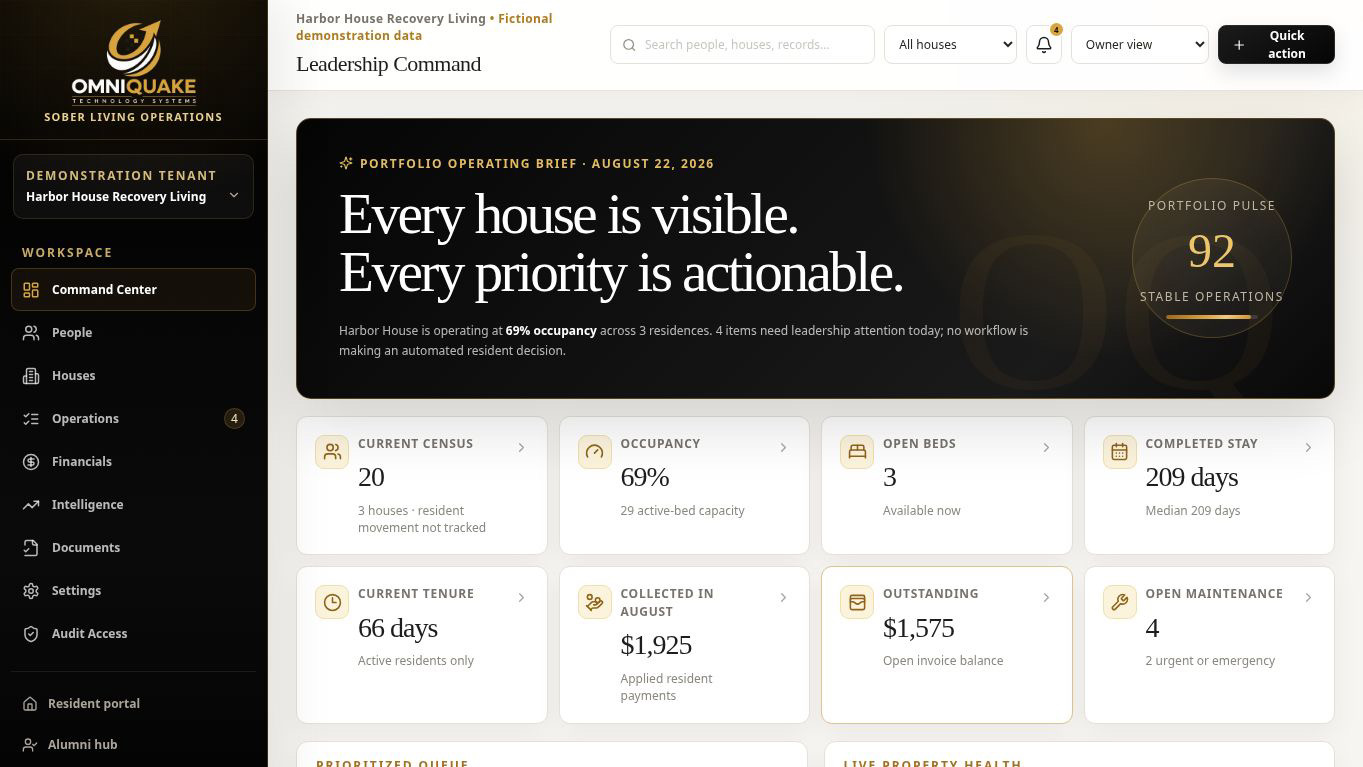
The leadership command center places capacity, finances, and priorities in a view designed for oversight, while staff have practical surfaces for daily work.
Recovery Residence Platform / Connected operations platform
A company-branded management product with distinct experiences for leadership, staff, residents, and alumni, each organized around the work that group needs to do.
The problem
The people involved in a recovery residence look at the operation differently. Leadership needs to understand capacity, finances, and priorities. Staff need practical views of availability and assignments. Residents need clarity about their own responsibilities, schedules, and requests.
Alumni participation has another purpose: continued connection through events, resources, and opportunities. The product needed to support that voluntary experience while keeping each interface focused on the people using it.
What we built
OmniQuake developed the Recovery Residence Platform as a private-label product customized around the operator's business and branding. Its leadership command center brings capacity, financial visibility, responsibilities, and operational priorities into a management view.
A visual bed board gives staff a working surface for availability and assignments. The resident portal presents daily responsibilities, schedules, requests, and resources around the resident's own tasks. These experiences serve different purposes within the wider operation.
The separate alumni network supports voluntary participation through events, resources, opportunities, and continued connection. Public product screens use fictional demonstration data to show the leadership, operational, and participant experiences without exposing resident records.
The working difference
Ownership, staff, residents, and alumni each have a working experience suited to their responsibilities. Operator-specific branding and customization carry through the product while the interfaces remain focused on oversight, daily operations, self-service, or continued connection.
Inside the software
Each experience has a purpose, with a working view shaped around the person using it.
The command center presents capacity, financial visibility, responsibilities, and operational priorities.
Operational views and the visual bed board support availability and assignment work.
Responsibilities, schedules, requests, and resources are organized around the resident experience.
A separate voluntary network provides events, resources, and opportunities beyond the resident experience.
What this project demonstrates
The leadership command center places capacity, finances, and priorities in a view designed for oversight, while staff have practical surfaces for daily work.
The resident portal gives responsibilities, schedules, requests, and resources their own branded experience rather than presenting a staff dashboard to every user.
The alumni network focuses on voluntary connection through events, resources, and opportunities, reflecting a different stage of the relationship.
Apply the idea
This approach is useful when a business needs several groups to participate in the same operation. A manager's overview, an employee's working screen, and a customer's portal can share a business context while presenting different tasks and information.
For a similar platform, we would map the roles first: the decisions each person makes, the records they use, and the requests or updates that move between them. That map would guide the initial modules and define what each group needs in the first release.
Related development services
More from OmniQuake
A custom platform for Got Real Recovery's 24-hour caregiving operation, giving caregivers a place to record daily care and ownership the context to review it.
Custom case management softwareA branded case management application that links everyday resident records and staff check-ins to the preparation, editing, and approval of monthly family reports.
Sports application developmentA football intelligence application that brings major-provider data into mobile scoreboards and analysis views, using 650 data points to generate score and player predictions.
Build with OmniQuake
Tell us where your team loses time. We’ll explore how software could help.